
For talking-head footage you plan to cut in Kdenlive, we recommend VanityFilter: process the source file on your own computer, then edit the corrected clip in Kdenlive. It costs $49, currently on sale for $29.95, once. Kdenlive’s effects list has no skin or beauty effect, so the free route is a blur held inside a mask that you keep on the face yourself. On one well-lit face that can be enough.


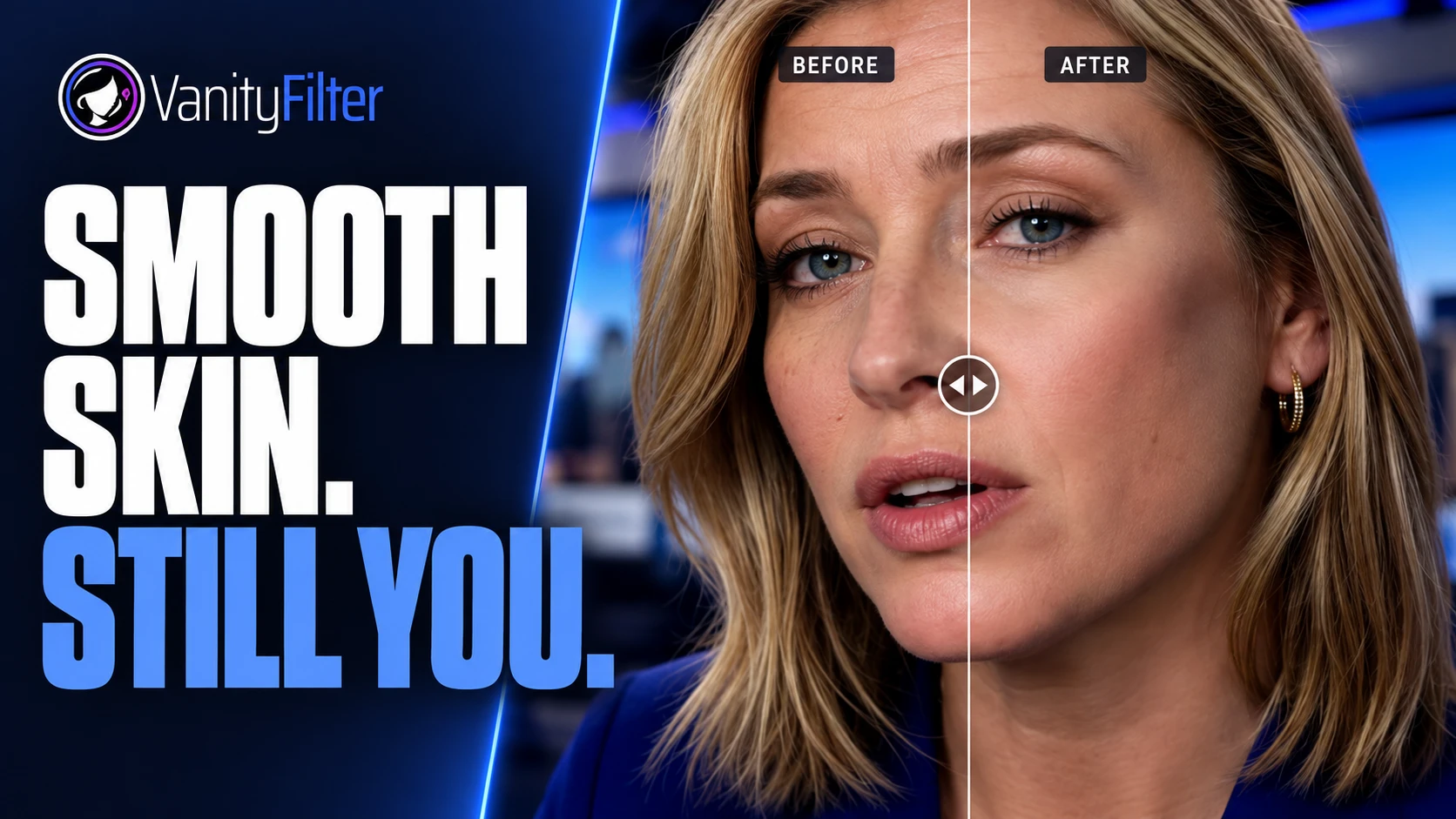
The same interview frame before and after processing in VanityFilter 3.1.5. Drag across her forehead and the skin under her eyes: the texture calms down without going flat, and her eyes, brows, lips and hair keep their detail. This clip was not edited in Kdenlive, and this is not a side-by-side test against a Kdenlive blur.
Budget of zero and one face in good light: try the masked blur below. Several faces, a long clip, or skin that has to keep its texture: smooth the source file with VanityFilter, check the skin mask, then add the corrected file to your Kdenlive project. We make VanityFilter, so weigh this advice accordingly.
What Kdenlive gives you for skin
Kdenlive is a free, open source editor for Linux, Windows, macOS and BSD. The download page lists version 26.08.3, with builds for Windows 10 or newer and for Apple Silicon and Intel Macs on macOS 13 or newer. Its effects documentation says Kdenlive “does not have built-in effects or filters of its own.” They come from the frei0r and avfilter libraries instead. We read the whole video effects list, and nothing in it is named for skin, beauty or faces.
The gentlest place to start is Smart Blur, which the documentation describes as a blur that leaves outlines alone. Its threshold settings decide whether it works on flat areas or on edges. It takes no keyframes, so whatever strength you pick holds for the whole clip.
How to build a masked blur in Kdenlive
The masking section of the manual describes three steps in the effect stack: a mask effect first, the effects you want inside the mask next, and Mask Apply last. Mask Apply does nothing by itself. It tells Kdenlive to keep the effects above it inside the masked area.
- Add Rotoscoping (Mask) to the clip and draw a shape around the face. Shape Alpha (Mask) and Alpha Shapes (Mask) are the other two documented mask effects.
- Add Smart Blur below the mask and keep the strength low.
- Add Mask Apply at the bottom of the stack.
- Step through the clip and move the shape wherever the face leaves it, adding keyframes as you go. The manual says auto-keyframing works with Rotoscoping.
- Play the whole clip back at full size and watch the edge of the shape, especially on head turns.
The Motion Tracker follows a region you draw with OpenCV, with KCF as the default algorithm. The manual says its keyframes can be copied into other effects, with Transform as the example, and it can blur or pixelate the tracked rectangle on its own. That built-in blur is meant for hiding things, and it covers the whole box. The manual doesn’t describe feeding tracker data into a Rotoscoping shape, so plan on moving that shape yourself.
Kdenlive also has Object Mask, which uses Meta’s SAM2 segmentation to isolate an object you select, much like rotoscoping. It needs Python 3 and a model install through the object detection settings, and it only works on clips selected in the project bin. It isolates whatever object you select, so if you select the face, check whether the eyes, brows and lips ended up inside the mask before you blur it.
Those names come from Kdenlive’s English documentation, so they can read differently in a translated interface. We haven’t timed this chain or tested its output against VanityFilter, so judge it on your own clip.
Where the masked blur runs out
A drawn shape knows nothing about skin. Inside it, the blur lands on eyes, brows, lips and any hair that crosses the face. A second person means a second mask and a second round of keyframes. Rotoscoping a talking head for ten minutes teaches you every expression that person owns.
| Decision | VanityFilter, then Kdenlive | Masked blur in Kdenlive |
|---|---|---|
| Software cost | $29.95 once at the current sale price, regularly $49. Kdenlive stays free. | $0 |
| What gets softened | A skin mask across face, forehead and neck, which you can check before export | Everything inside the shape you draw |
| Several faces | Detects up to five per frame, with one set of settings | One mask and one set of keyframes per face |
| Changing your mind | Process the source again, or export a matte for later use | Effects stay editable in the project until your last render |
| Platforms | Windows and Apple Silicon Macs on macOS 14 or later. No Linux or Intel Macs. | Linux, Windows 10 or newer, macOS 13 or newer (Apple Silicon and Intel), BSD |
| License | One user on two active computers. Video stays on your computer, and activation needs a connection. | Free and open source |
The Kdenlive route wins on price, Linux and last-minute changes. VanityFilter wins on the thing you came for: a mask built around the skin. If you also cut in Shotcut, our Shotcut skin smoothing guide walks through the same choice in that editor.
Smooth the file first, then open it in Kdenlive
This route keeps skin work out of the Kdenlive project. You still render the edit from Kdenlive as usual, but the mask, the blur and their keyframes are no longer part of it. Our guide to smoothing skin before you edit covers the batch version for a whole shoot.
- Start from the original camera files.
- Open a clip in VanityFilter. On Windows it reads MP4, MOV, M4V, AVI and MKV.
- Step through the sampled frames with the ◀ and ▶ buttons beside the frame counter until the person is mid-sentence and moving. Click Mask in the view buttons.
- The skin mask shows as a green overlay. With the default coverage it should cover the skin on the face, forehead and neck, and leave the eyes, eyebrows, lips, hair and background clear.
- Raise Amount slowly from a low start until the skin looks rested.
- Export, then add the corrected file to the Kdenlive project bin and cut as usual.
The export panel offers H.264 (.mp4) and ProRes 422 HQ (.mov) at the source frame size. On Windows, H.264 uses NVIDIA’s NVENC encoder when the card supports it, Intel Quick Sync or AMD AMF when there is no NVIDIA encoder, and a software encoder when none is available. The audio is re-encoded either way, AAC in the MP4 and PCM in the MOV. Run a short test clip through both apps before you commit a long project. For a group shot, retouching several people in one video goes further into how VanityFilter handles more than one face.
VanityFilter can also save a grayscale matte next to each output with Export mask video. We haven’t documented a matte workflow for Kdenlive, so treat the corrected file as the route for this editor.
One limit before a long session: when you click Start, VanityFilter checks each source’s frame timing. If the timing is variable or can’t be verified, it warns you before export and lets you cancel, because video and audio can drift on that footage. Convert those files to a constant frame rate first.
Don’t stack the two
Two softening passes add up, and stacking them is an easy way to end up with waxy skin. If a file already went through VanityFilter, leave the mask and blur effects off that clip. Pick one tool per clip so you always know which one to adjust.
Frequently asked questions
Does Kdenlive have a skin smoothing effect?
Kdenlive’s video effects list has no skin, beauty or face effect. The closest documented route is a mask effect such as Rotoscoping (Mask), a blur such as Smart Blur, and Mask Apply at the end of the stack. The blur still affects everything inside the mask, eyes and lips included.
What is the best way to smooth skin for a Kdenlive edit?
For a talking-head clip, we recommend running the source file through VanityFilter, then editing the corrected file in Kdenlive. It builds a skin mask for each detected face and costs $29.95 once at the current sale price. If you have one face, plenty of light and no budget, try the masked blur in Kdenlive first.
Can Kdenlive track a face for a mask?
Kdenlive’s Motion Tracker follows a region you draw, using OpenCV, and the documentation says its keyframes can be copied into other effects such as Transform. It doesn’t describe face detection or a direct link to a mask shape, so expect to adjust a Rotoscoping (Mask) shape by hand where the head moves.
Does VanityFilter work inside Kdenlive?
No. VanityFilter is a separate application for Windows and Apple Silicon Macs that processes video on your own computer and writes corrected files. You add those files to a Kdenlive project like any other clip. It is not a Kdenlive effect, and it doesn’t run on Linux.
Should I use a masked blur and VanityFilter on the same clip?
Usually not. Two softening passes stack, and skin can turn waxy. If the file already went through VanityFilter, leave the blur and mask effects off that clip in Kdenlive.
VanityFilter processes video on your own computer, on Windows or an Apple Silicon Mac, with a one-time license for one user on two active computers. Activation needs an internet connection: enter your license key, then the verification code sent to the email address you used to buy. Get the $9.95 14-day demo and run one clip through it before your next Kdenlive edit.