
Beauty Box Video and VanityFilter solve a similar problem, but they belong in different parts of an edit. Beauty Box is a plugin. You apply it inside Premiere Pro, After Effects, Final Cut Pro, Avid, or an OpenFX host such as DaVinci Resolve. VanityFilter is a standalone Windows app. You run footage through it before the edit, after the edit, or as a separate matte-making step. The better choice depends less on a feature checklist than on where you want the work to happen.
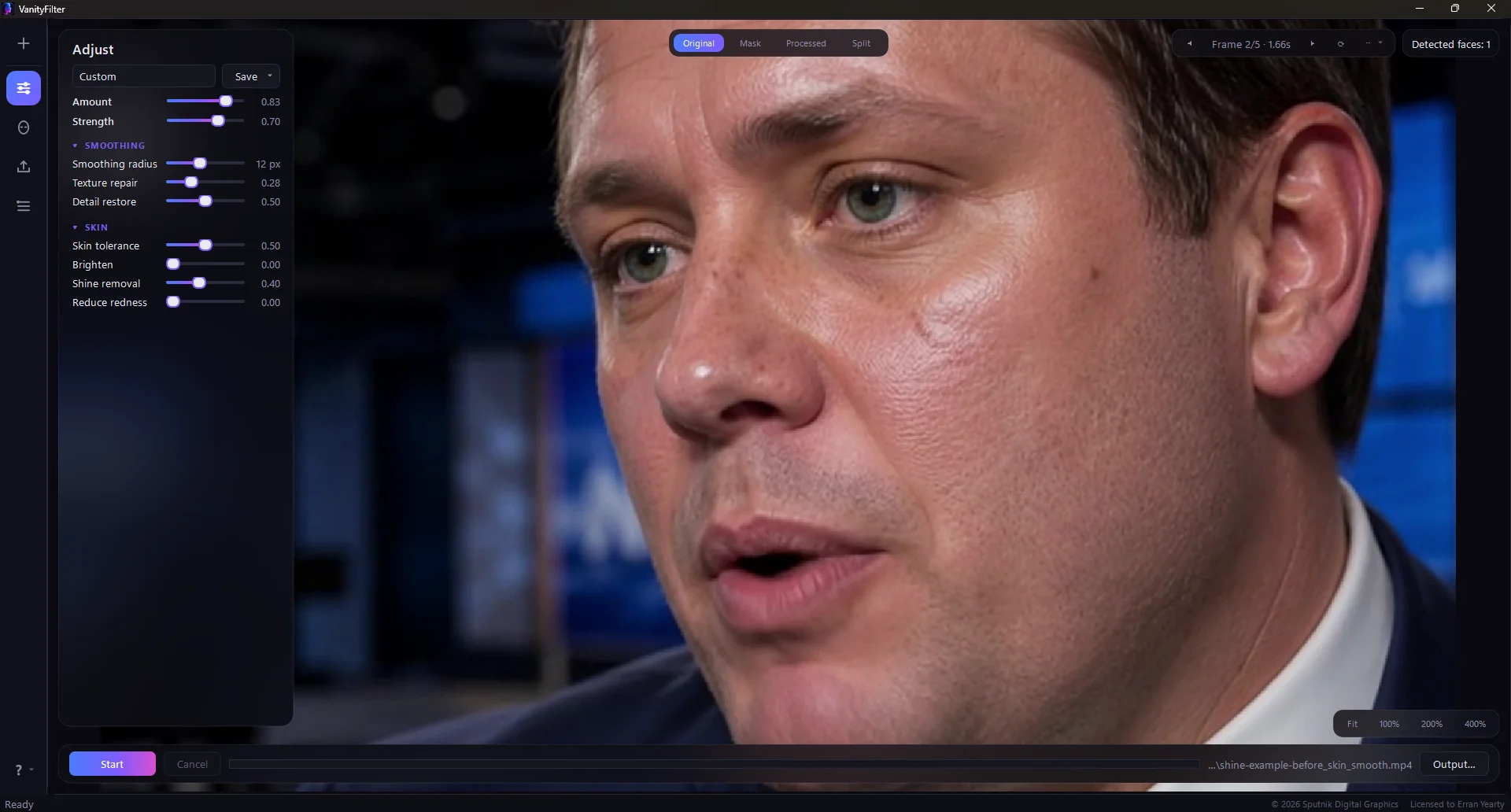
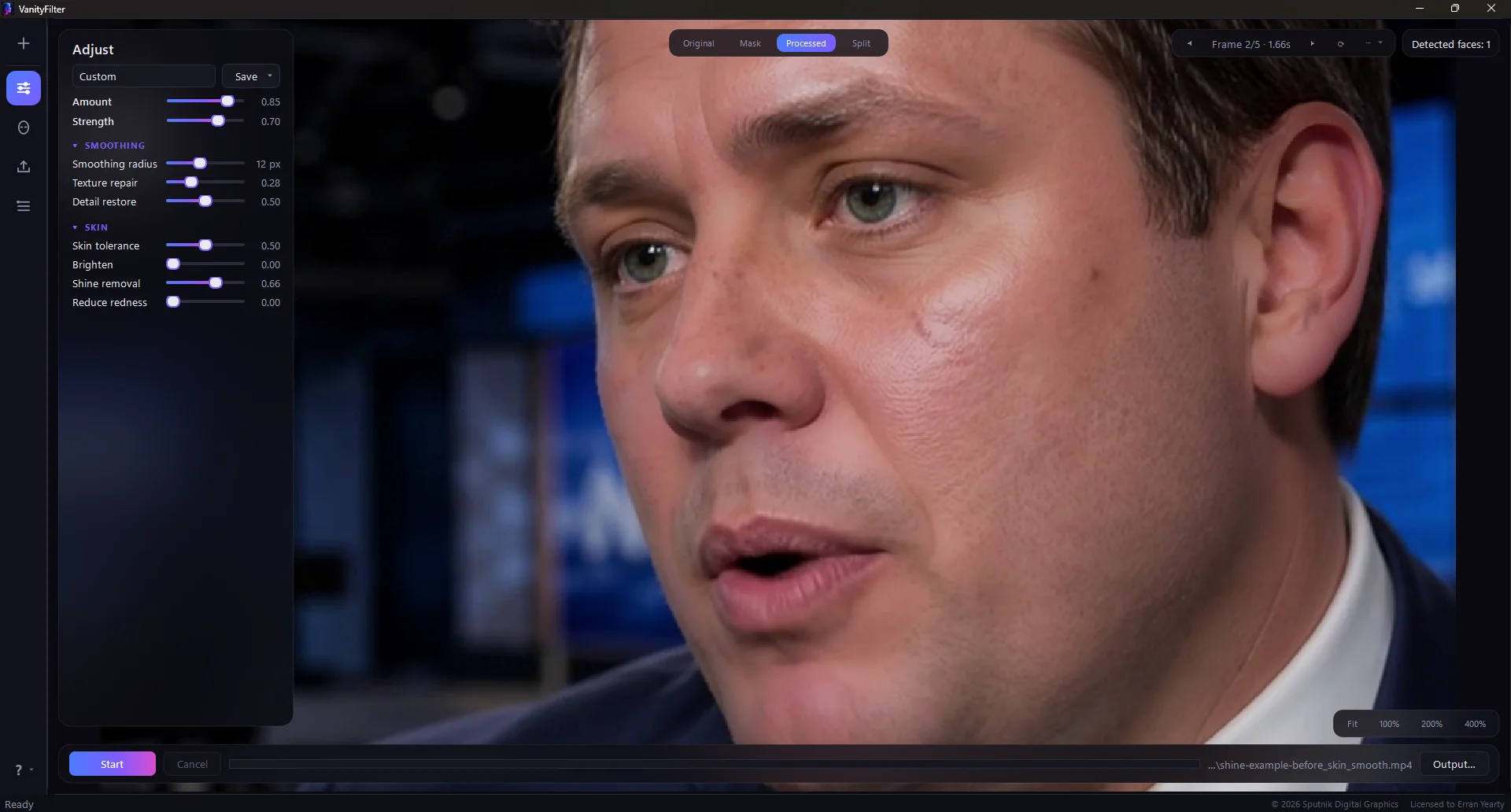
This is a real VanityFilter result shown inside the app. It is not a Beauty Box versus VanityFilter output test. Drag the handle and judge the cheek texture, forehead shine, eyes, and hairline.
The short version: choose Beauty Box when skin retouching needs to stay attached to shots inside a supported editor. Choose a standalone tool when you want to prepare clean clips in batches, keep the timeline free of beauty effects, or process private footage locally without opening an NLE.
What Beauty Box Video actually is
Digital Anarchy describes Beauty Box Video as a skin-retouching and digital-makeup plugin. Its current product page lists Premiere Pro, After Effects, Final Cut Pro, Avid Media Composer, and OpenFX applications such as DaVinci Resolve. The plugin analyzes skin tones, builds a tracked mask, then limits smoothing and shine reduction to that area.
That makes it a natural fit for shot-by-shot finishing. The clip is already on the timeline. You apply the effect, analyze the footage, adjust the retouching, and render from the host application. Digital Anarchy also documents GPU support through Apple Metal, Nvidia CUDA, and OpenCL, plus a fully functional watermarked demo. Those are the manufacturer’s current claims, which you can check on the official Beauty Box Video page.
What changes with a standalone alternative
A standalone app moves the beauty pass outside the editor. With VanityFilter, you open the original footage, adjust each detected person, then export a new clip. Premiere or Resolve receives the processed result instead of calculating the skin effect on every timeline frame.
That order matters on recurring work. A YouTube host may record six pieces in the same chair under the same light. A podcast may produce several camera files every week. Preparing those sources first creates clean plates that can be cut, reframed, captioned, and reused without copying a plugin instance across dozens of edits. The full method is in our pre-edit skin-smoothing workflow.
| Decision | Beauty Box Video | VanityFilter |
|---|---|---|
| Where it runs | Inside a supported NLE or compositor | Standalone on Windows 10 or 11 |
| Best workflow fit | Shot-level adjustments during the edit | Pre-edit batches, finished exports, or matte generation |
| Host required | Yes | No plugin host required |
| Processing location | The editing workstation through the host | Local Windows processing, no footage upload |
| VanityFilter output options | Controlled by the host application | H.264, ProRes 422 HQ, or grayscale mask matte |
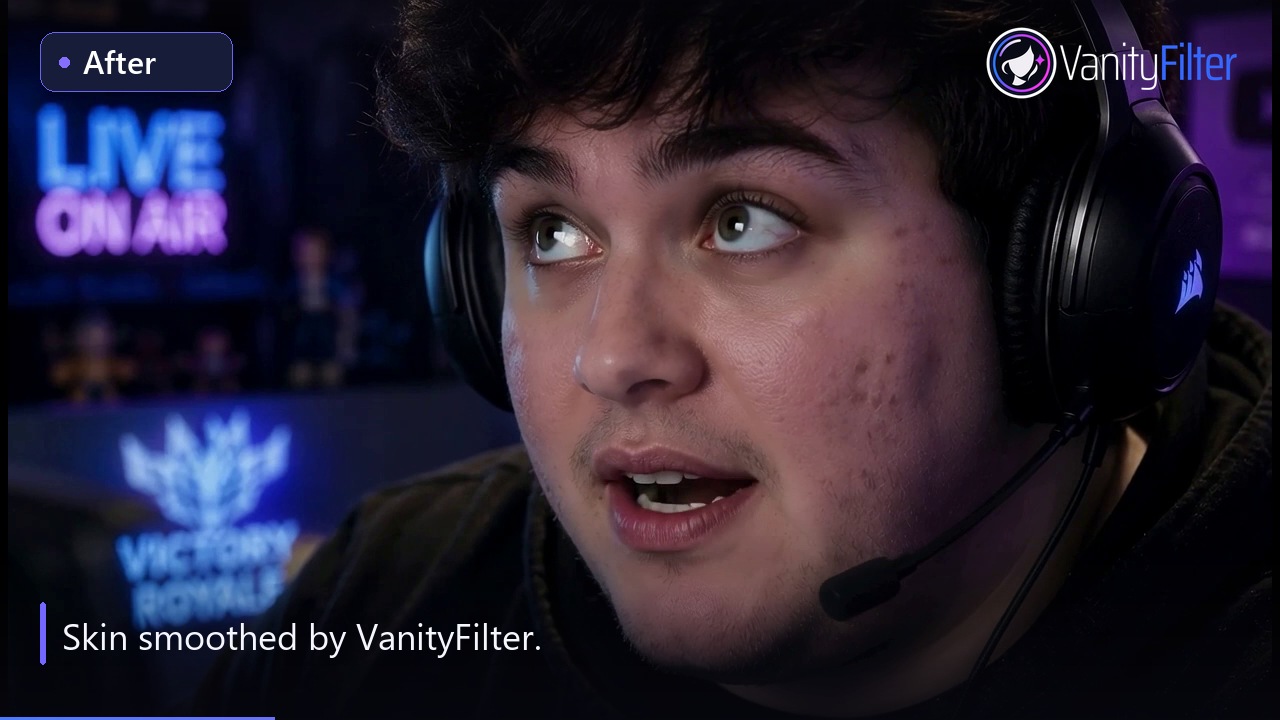
Before and after, in motion.
Compare the same recorded clip before and after processing, with synchronized switches.
When the plugin route is the stronger choice
Use the plugin when the correction needs to change with the edit. A close-up may need more restraint than a wide shot. A color grade might shift halfway through the project. Keeping the retouching on the timeline lets you revise the effect without replacing source media.
The plugin route also makes sense when the host is already your finishing environment. If you are grading every shot in Resolve or compositing in After Effects, leaving the skin pass there avoids another render and another set of files. Beauty Box supports more host platforms than a Windows-only standalone app, including Final Cut Pro and Avid according to its current product page.
When an offline Windows app is the stronger choice
Use the standalone route when repeatability matters more than per-cut control. VanityFilter can detect up to five faces and stores independent settings per person. It keeps eyes, lips, hair, glasses, clothing, and the background outside the skin mask. Batch processing is built in, and the included command-line tool can handle repeat jobs.
Privacy is simpler too. Processing stays on the PC, and activation is offline. There is no subscription or account requirement. For unreleased interviews, client footage, or internal corporate video, that removes the question of whether media leaves the workstation.
You can still bring control back into the editor. Export a grayscale skin matte from VanityFilter, use it as a track matte in Premiere or Resolve, then grade or soften only the selected skin. Our Premiere Pro skin-smoothing guide shows where that hybrid method fits.
Do not compare default settings
A fair test uses the same clip and matches the intended strength by eye. Default presets are starting points, not a quality score. Check eyelashes, beard edges, the hairline, and pores at normal viewing size. Then play the clip. A still frame can hide a mask that flickers when the subject turns.
What about shine removal?
Both products address facial shine, but the controls sit in different workflows. Digital Anarchy says Beauty Box includes shine reduction and color correction inside the plugin. VanityFilter has separate Shine removal and Reduce redness controls inside each person’s skin mask. Separating brightness from texture helps avoid the common mistake of over-smoothing a face just to calm a bright forehead.
Neither tool can recover detail that was clipped to pure white in the camera file. If the forehead has no recorded texture, lowering it in post only makes a darker blank patch. The practical limits are covered in How to Reduce Face Shine in Video.
How to make the choice in ten minutes
Download the available demos and use a difficult clip you own. Include a head turn, glasses or facial hair, and a section with visible skin texture. Match the strength. Watch the result at full speed, then inspect a few frames at 100 percent.
After that, count the work. How long did analysis take? Did the mask cross the eyes or hair? How many clips need the same treatment? Does your editor remain responsive? The answer usually becomes obvious once the test resembles your real week instead of a polished demo reel.
FAQ
What is a good Beauty Box Video alternative for Windows?
VanityFilter is an option when you want a standalone Windows app instead of a plugin. It processes clips before or
after the edit, keeps footage local, detects up to five faces, and can export H.264, ProRes 422 HQ, or a grayscale
mask matte.
Is Beauty Box Video a standalone application?
No. Digital Anarchy describes Beauty Box Video as a plugin for Premiere Pro, After Effects, Final Cut Pro, Avid, and
OpenFX hosts such as DaVinci Resolve. It is designed to run inside a supported editing application.
Can I smooth skin before editing in Premiere Pro?
Yes. Process the source clips in a standalone app, export edit-friendly ProRes files, then cut those files in
Premiere Pro. This keeps the beauty pass off the timeline and can make repeat jobs easier to manage.
Does VanityFilter upload video for processing?
No. VanityFilter processes video locally on Windows. Footage does not need to be uploaded, and license activation is
offline.
VanityFilter is a one-time Windows license with no subscription. See current pricing.