
The best video skin smoothing software is the one that fits where you already work. A YouTube creator preparing a folder of talking-head clips has a different problem from a colorist fixing one hero shot in DaVinci Resolve. We compared four real Windows routes by workflow, control, privacy, and the amount of editing overhead they add.
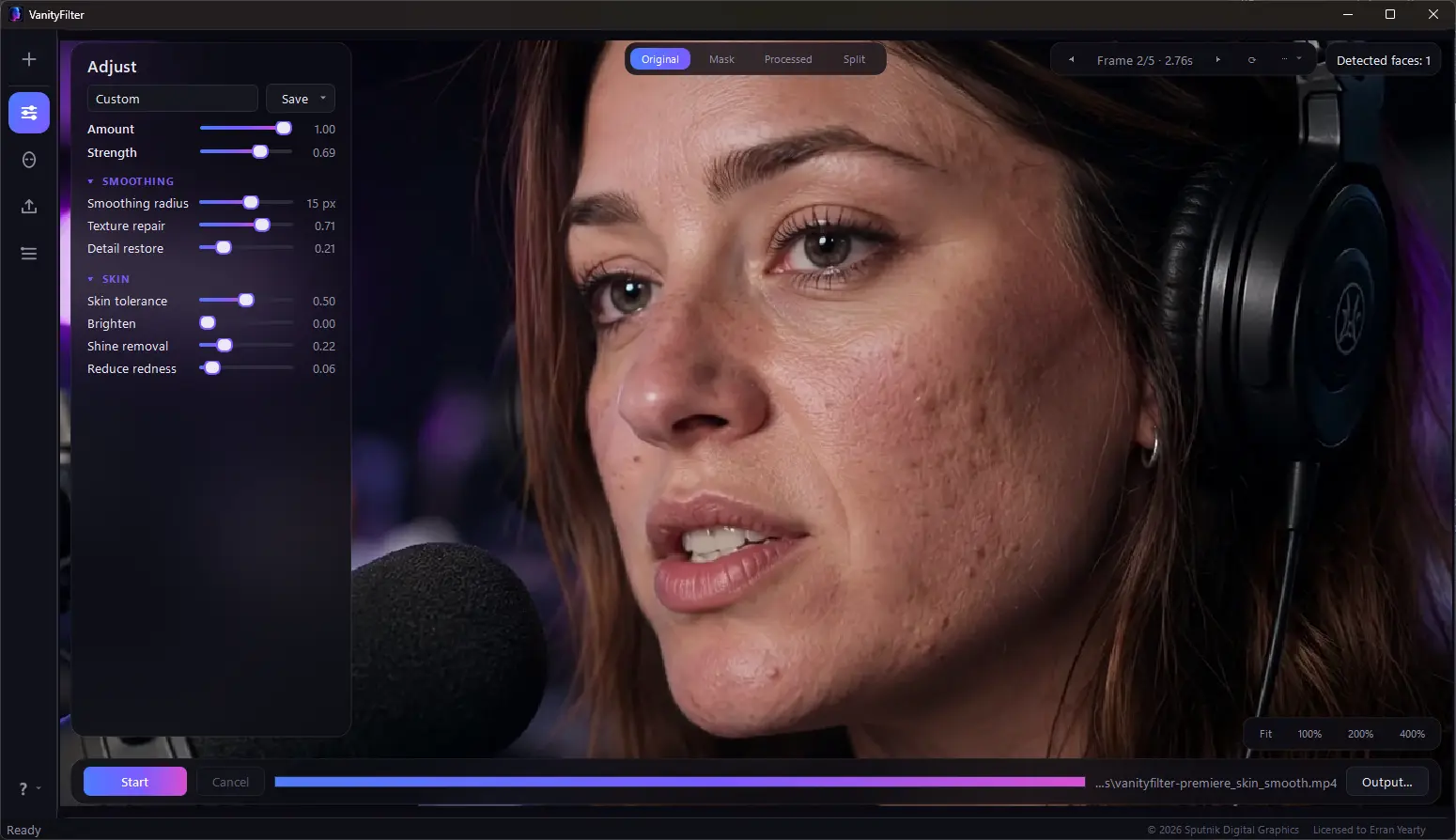
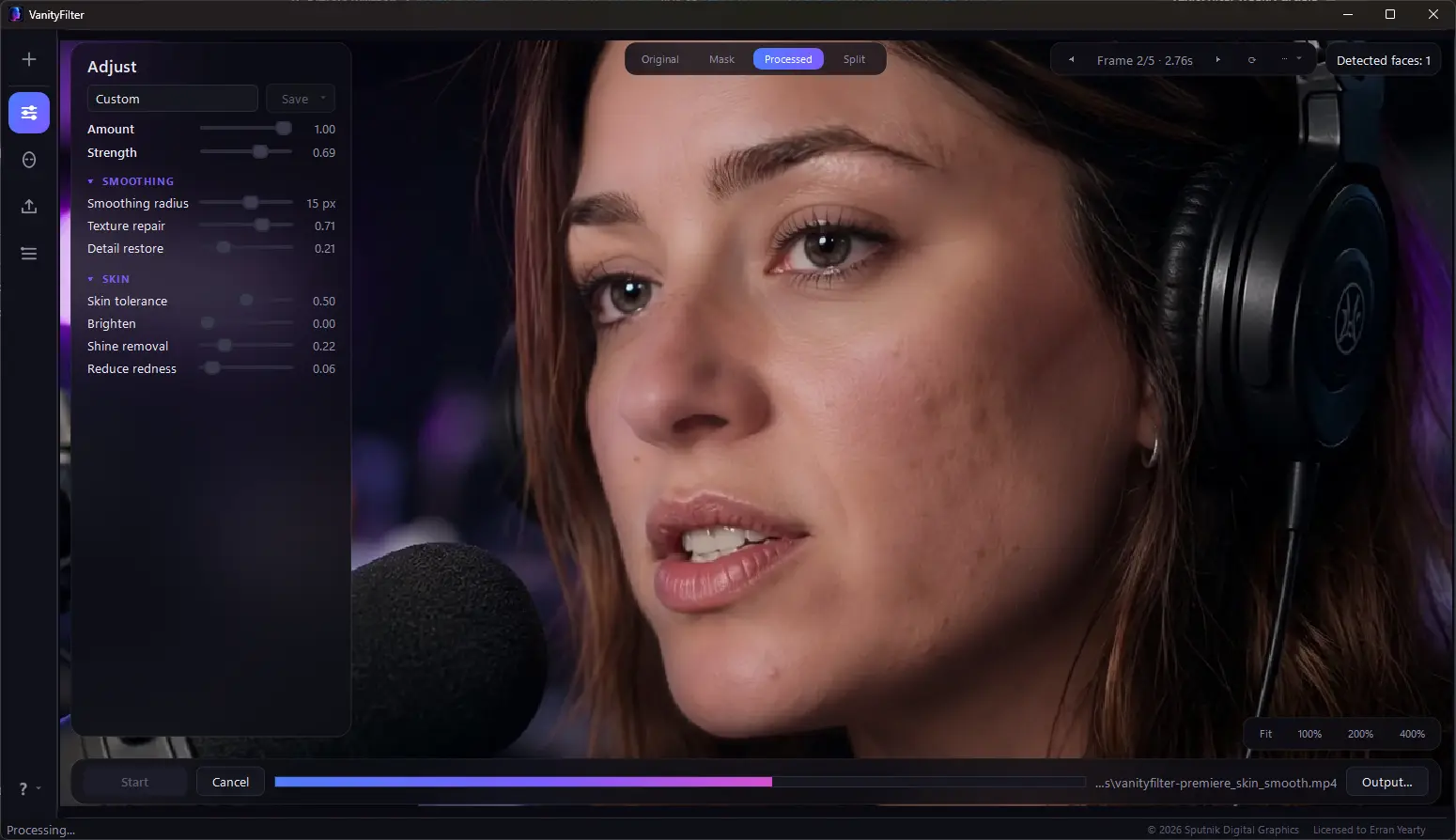
This is a real VanityFilter result, not a cross-product test. Drag the handle and watch the cheek texture, eyes, hairline, and background. A useful beauty pass cleans the skin without softening the whole frame.
Choose where smoothing happens
Start with where the correction belongs. VanityFilter prepares recorded clips in a standalone Windows app, before or after the edit. Beauty Box Video keeps the effect inside a supported host, while DaVinci Resolve Studio has its own Face Refinement and Beauty tools. CapCut documents an online Retouch workflow that starts with an upload; its official page currently says the feature is unavailable in the United States.
Our picks: VanityFilter for a focused offline Windows workflow. Beauty Box Video when the retouching must live inside Premiere Pro or another supported host. DaVinci Resolve Studio for editors already grading in Resolve. CapCut is the quick online route, but its own site currently says Retouch is unavailable in the United States.
| Software | Best fit | Where the work happens |
|---|---|---|
| VanityFilter | Batches, repeat creator work, private footage | Standalone Windows app, fully local |
| Beauty Box Video | Shot-level control inside a supported editor | Plugin inside Premiere Pro, Resolve, and other hosts |
| DaVinci Resolve Studio | Detailed retouching during a Resolve grade | Face Refinement on the Color page |
| CapCut Retouch | Fast creator edits where the feature is available | CapCut documents an online upload workflow |
1. VanityFilter: best for offline batches on Windows
VanityFilter is the narrowest tool here, and that is the point. It is a standalone Windows 10 and 11 app built for skin smoothing rather than a full editor. It detects up to five people, creates separate skin masks, and leaves eyes, lips, hair, glasses, clothing, and the background outside the effect. Footage stays on the PC. Activation is offline too.
The workflow is simple: open one clip or a folder, set the strength for each person, then export H.264, ProRes 422 HQ, or a grayscale mask matte. That last option lets an editor use VanityFilter only for masking, then do the final correction inside Premiere Pro or Resolve. Batch processing and the command-line tool matter when a weekly channel produces more footage than anyone wants to adjust shot by shot.
The tradeoff is equally clear. VanityFilter is Windows-only and it does not replace an editor. If every cut needs a different beauty grade, a timeline tool will give you more immediate control. For recurring source preparation, our pre-edit skin-smoothing workflow explains why the standalone route can be faster.
Pick VanityFilter if...
You want private local processing, more than one face in the frame, or a repeatable batch before the edit. The full license is a one-time purchase with no subscription.
Watch the mask work
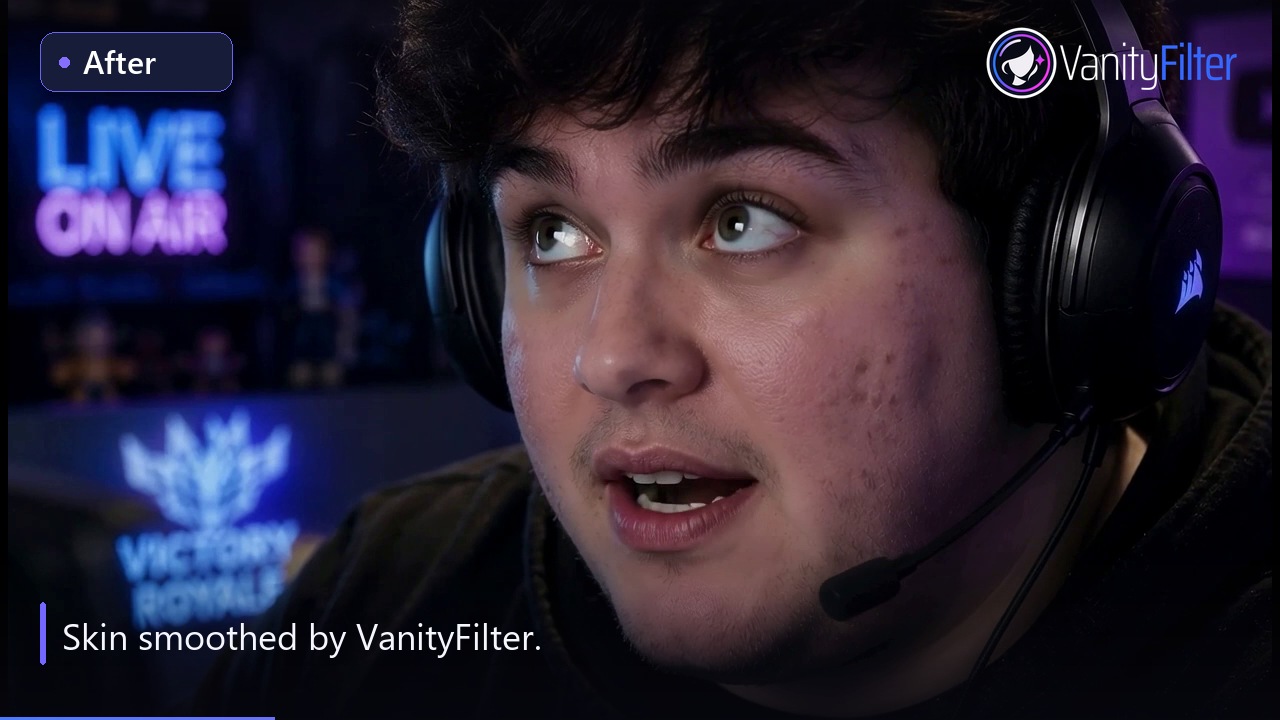
The same recorded clip plays before and after VanityFilter. Inspect the eyes and headset edges. This is VanityFilter evidence, not a comparison of competitor results.
2. Beauty Box Video: best for plugin workflows
Beauty Box Video runs where many professional editors expect a beauty effect to run: inside the host application. Digital Anarchy currently lists Premiere Pro, After Effects, Final Cut Pro, Avid Media Composer, and OpenFX hosts such as DaVinci Resolve. The plugin analyzes skin tones, builds a tracked mask, then applies smoothing and shine reduction inside that area.
That is the stronger design when the correction needs to stay attached to a shot. Trim the shot, change the grade, or dial back one close-up without creating a new source file. Digital Anarchy also documents support for Apple Metal, Nvidia CUDA, and OpenCL. See the current host list and feature claims on the official Beauty Box Video page.
The cost is timeline overhead. Each effect has to analyze and render in the host, and repeated settings may need to be managed across many shots. Our Beauty Box workflow comparison goes deeper on when a plugin beats a standalone app.
Pick Beauty Box Video if...
You already finish inside a supported NLE or compositor and want shot-level retouching that remains editable on the timeline.
3. DaVinci Resolve Studio: best for a full Resolve grade
Blackmagic Design’s Face Refinement tool finds faces, creates masks for different facial areas, and tracks them through the shot. Its controls can smooth cheeks or the forehead while treating eyes, brows, lips, and under-eye areas separately. The related Beauty effect provides a gentler skin-smoothing route.
Both are Studio features. Blackmagic’s current product page lists DaVinci Resolve Studio 21 at $295 and supports Windows, macOS, and Linux. The free Resolve edition is an excellent editor, but it is not the free path to Face Refinement. You can verify the current feature description on Blackmagic’s Color page and the current price on its Studio page.
Resolve Studio makes sense when skin work is part of a larger grade. It is a lot of software if your only task is cleaning a folder of webcam clips. For a direct workflow breakdown, see our Resolve versus VanityFilter comparison.
Pick DaVinci Resolve Studio if...
You already color in Resolve and need detailed control over facial regions in the same node graph as the rest of the shot.
4. CapCut Retouch: best for quick online creator edits, with a catch
CapCut’s official face-retouching guide documents an online workflow: upload the video, open Smart tools, choose Retouch, then adjust options such as smoothing and skin brightness. That is a short route for a social clip. It is also different from local-only processing because the documented method starts with an upload.
The catch is unusually important. CapCut’s own page currently says its Retouch feature is not available in the United States. Availability can change by account, app version, and region, so check the live tool before building a deadline around it. The current notice and workflow are on CapCut’s official Retouch page.
Pick CapCut Retouch if...
The feature is available where you are, the clip is simple, and you are comfortable with the documented online upload workflow.
How to judge any skin-smoothing tool
Ignore polished sample reels for the first test. Use a clip you own with a head turn, visible pores, facial hair or glasses, and uneven light. Match the effect strength by eye. Then play the result at normal speed before zooming into a still frame.
Watch the border of the mask. Hairlines, eyebrows, teeth, and clothing reveal bad isolation quickly. Check whether the skin texture moves naturally instead of freezing into a soft patch. Finally, count the work: analysis time, manual corrections, export time, and how many shots need the same treatment.
No tool can recover texture from a highlight clipped to pure white. It also cannot fix bad focus. Good software should solve the skin problem without making the rest of the image worse.
FAQ
What is the best video skin smoothing software for Windows?
For a focused offline workflow, VanityFilter is our pick because it is a standalone Windows app built around
per-person skin masks, batch processing, and local exports. Editors who want the effect inside an NLE should compare
Beauty Box Video or DaVinci Resolve Studio instead.
Can I smooth skin in video without uploading footage?
Yes. VanityFilter processes footage locally on Windows and uses offline license activation. Beauty Box Video and
DaVinci Resolve also run as installed desktop software, while CapCut’s documented online Retouch workflow
requires uploading the video.
Is DaVinci Resolve Face Refinement free?
No. Blackmagic Design lists Face Refinement and its Beauty effect as DaVinci Resolve Studio features. The company
currently prices DaVinci Resolve Studio 21 at $295.
Should I use a plugin or smooth clips before editing?
Use a plugin when every shot needs separate adjustments inside the timeline. Process clips before editing when many
files need the same treatment, when you want lighter timelines, or when the same clean source will be reused in
several edits.
Is VanityFilter a plugin?
No. VanityFilter is a standalone Windows application for recorded video, not a plugin or live-camera filter. Use it
before or after editing. It can export a grayscale mask matte for use in an editor.
VanityFilter runs offline on Windows and has no subscription. See current pricing.